Showing posts with label history. Show all posts

7.20.2011

frankfurt am main

It seems like I always have a layover in Frankfurt whenever I visit Europe. Except for the fact that its airport is too small for the amount of people it serves (hence it always being crowded) it is a nice city to stop by if you have enough time to leave the airport. It only takes about fifteen minutes to get to the city center.

In reference to the original inhabitants of the area, Frankfurt means the 'ford of the Franks.' The main attraction is the Römerberg (Roman Hill) where the elections of the emperors of the Holy Roman Empire took place for 600 years. In this area, eleven buildings make up the Römer (The Roman). They are all said to be connected by hallways and labyrinths. The center building of the three gable-roofed structures was where the emperor's coronation would take place. It is known as the Haus Römer (Roman House) while the left and right one are called Alt-Limpurg and Löwenstein respectively. Many of the buildings were heavily damaged during World War II and reconstructed thereafter. The picture below is dated from the late 1880s.


Much detail was added in the recent reconstruction of these buildings. The wooden balcony for instance was added so that ceremonies could take place before a crowd of people. One interesting fact about these buildings is that the rulers bought them from wealthy merchants rather than building separate structures for their city.


Directly across from the Römer are these buildings in the picture above. All of them have been reconstructed and now have restaurants on the bottom floors.


Dom Sankt Bartholomäus (Saint Bartholomew's Cathedral) is the city's main cathedral. It was constructed in the 14th and 15th centuries on the foundations of an earlier Merovingian building. The building was destroyed in an 1867 fire and rebuilt in its modern day form.

7.18.2011

sabi palace

I finally got to visit Sabi Palace that was recently constructed. It was indeed an impressive site. Nevertheless, being the critic I am, two things bothered me. First, the palace was not built on the original site and secondly, it felt more like visiting an amusement park rather than a site from the past. The first problem I can overlook because it really doesn't matter, except to the few zealous historians and archaeologists. I did have issues with the second. Once inside, there are speakers blasting 'traditional Korean music' and large plasma televisions inside the buildings playing history lessons. Of course those who build these things have to consider the monetary returns or else they would go bankrupt. I can understand that. But I think they were only thinking of the returns. I personally don't think they should have built the palace. Instead, they should have rebuilt the long-gone Buddhist structures that we know existed during the Baekje Kingdom (e.g. Mireuksa) and actually have them function as places of worship. Like other temples in Korea, these sites could reach a point where they would be self-sustaining.

Still, it is better than having nothing at all and I would recommend this place to anyone interested in early Korean history. There is a museum next door where you can learn a bit about the early connection between the Baekje Kingdom and early Asuka Japan.


In the background, one can see Neung Temple and its pagoda. Unfortunately, it is not used as a place of worship but is just a small part of the entire complex.


This is suppose to be a replica of Wirye Fortress, the very first fortress that was located in Seoul. It is interesting to see that the tiled and gabled roofs have not yet become a part of Baekje architecture.

6.27.2011

mireuksa

Mireuk Temple was established in 602 by King Mu of the Kingdom of Baekje. Legend says that King Mu and his queen saw a vision of the Maitreya Buddha at a pond and subsequently had the pond drained for the construction of this temple. It was then dedicated and named after the Maitreya Buddha.


The reconstructed plan of the temple is rather unique; it does not exist in China, Japan, or in other parts of the Korean Peninsula. The two stone pagodas flank the larger wooden one in the center and corridors separate it from the rest of the complex. One of the arguments for such tall pagoda structures in early East Asian History is that it was to legitimize the power of the ruling class. This can be seen in major pagoda construction during the Tang Dynasty, Silla Kingdom, and early Yamato Kingdom of Japan. The wooden pagoda is said to have been built by a craftsmen named Abiji. 


The Western Pagoda survived into modern times and is the oldest and largest stone pagoda to survive from the Baekje Kingdom. The Eastern Pagoda was recently reconstructed after extensive studies of the Western Pagoda. The Western one is now undergoing thorough excavations and will be reassembled sometime in the future. The stone pagoda showed how Baekje craftsmen adapted their knowledge of woodworking to stone. Except for the simplification of the bracketing system, most of the construction techniques mimic wooden ones.

10.20.2010

how it was a hundred years ago

This was Los Angeles once. A little bit of perspective can make one quite thankful. 

How it was a Hundred Years Ago by George Garrigues 

If you were living in Los Angeles a hundred years ago: 

You would take the streetcar to work. Another streetcar might kill you when you got off. You would work six days a week. If you were a bank clerk you would work Saturday nights. If you were really, really lucky you might get a week’s paid vacation. Perhaps a 10-year-old would be piloting the elevator in your building (don’t worry; the building wouldn’t be higher than five or six floors). You would shop Downtown (even, perhaps, for groceries). 

If you were black, you would live near the railroad tracks. If you were black you could be a policeman or a fireman, but not police chief or fire chief. You would have to sit in the balconies of the theaters. You could be a lawyer or a doctor or a minister or a porter. If you were white and had a fancy title or owned a business, you might live on Ninth Street or on Adams. 

If you lived in Hollywood, you might be raising flowers or fruits. If you lived in the San Fernando Valley, you definitely would be raising something or growing something or tending to some kind of animal. 

If you spoke Spanish in your home, you would be called a cholo. A cop could arrest you ‘on suspicion’ and then try to figure out what to charge you with. You could be arrested for speaking to a crowd without a permit. You might be treated with radium and milk for breast cancer. 

You could take Angels Flight to your mansion on Bunker Hill. If you were a police officer, you might have to work from 3 a.m. to 6 p.m. You wouldn’t have a union or even an officers’ association. Likewise, a streetcar conductor would work from 5 a.m. until 11 p.m. (well, on the Fourth of July at least). 

You could go to see a “coon show,” or even be in one if you had some blackface makeup (or already had a black face). You could see Lillian Russell, Sarah Bernhardt or Booker T. Washington — in person. All ladies would be women, but not all women would be ladies. You would have to buy textbooks for your schoolchild at jam-packed Downtown stores. The schools would be overcrowded. If you were a woman you could join a club and try to do good things for your community and your country. You could also work six days a week in a department store. If you were a married woman, you would always use your husband’s name, with Mrs. in front of it. 

You would take the Pacific Electric to Venice or Long Beach as often as you could, unless you already lived there. If you lived in Venice, you could get fifty dollars in gold for having a baby there. If you lived in San Pedro or Wilmington you might decide being a part of L.A. would be better than watching your trees die of thirst. You could go to an ostrich farm and see them pluck the ostriches. 

It's very unlikely you’d be one of the 20 people murdered in a year within the city limits. Ghouls might dig up your grandparents’ bones. No, strike that; your grandparents were probably neither born nor buried in Los Angeles — unless you were of Mexican (or French) descent. You would get the flu in December or January, but you would call it the grippe. 

If you were Chinese, there would be about 3,000 other people like you living in or near the Plaza, and most white folks would think you odd, dirty and smelly. You would probably be a man and, if so, you would wear your hair in a pigtail. But you’d be allowed to march in the Fiesta parade — because then you’d be considered colorful. 

Your local minor-league baseball team would be called the Looloos. You could get two years in the clink for stealing seven cents from a church poor box. You’d be shocked that the donor of Griffith Park was charged with trying to murder his wife. But you’d be happy that she survived and divorced him. 

If you were a man living in Hollywood, chances are you would vote to outlaw the sale of beer and wine except at drug stores. If you were a woman living there, you couldn't vote. If you lived in Watts, you’d be surrounded by nature. If you died, chances are your final illness would be diagnosed as tuberculosis.

10.06.2010

reconstruction of the kingdom of baekje

Baekje was one of three kingdoms that endless fought for dominance on the Korean Peninsula until its demise from a combined Silla-Tang onslaught in the year 660. Many government officials and aristocrats, instead of being captured by the incoming force, committed suicide by drowning in the Baekma River. Others fled to the court in Japan and were warmly welcomed into the royal court.

According to the Nihon Shoki and Samguk Sagi, we know that Baekje and Yamato Japan had a very close relationship. Architects, scholars, doctors, and priests from Baekje went to the Yamato court to spread Buddhism, writing, architecture, and other advanced continental ideas. Sadly however, for the past fifty years or so, this idea was a point of major friction between many Korean and Japanese people. The question of who influenced who, who created what, or what really happened in history had severe ramifications on the history of the time. Imperial Japan in the early 20th century used this relationship as one of their justification for annexing Korea for instance.


Today, save for a few artifacts and some stone pagodas, not much has survived. So when the city of Buyeo (Sabi, the old capital of Baekje) decided to bring back the main palace and a temple 1500 years later, it definitely did stir mixed emotions. The skeptics and pessimists knew that the buildings could never be reconstructed to what they actually looked like since no architecture from the kingdom has survived. Those excited did not care for the integrity of the architectural style of course since a complex like this would bring in tourist dollars as well as some pride in knowing that a great kingdom had existed there. The city went ahead and fourteen years later, the complex of Sabi Palace, Neung Temple, and a peasant's village was opened to those curious about this lost kingdom.


Without any intact architectural examples, the architects who build the complex began with a chimi that was discovered at the site of Mireuksa Temple, Baekje's most important state temple. This chimi bore close resemblance to those used on temple architecture that come from that time period in Japan. From there, they went to Japan to find inspiration for the palace and temple, knowing that Baekje architecture and Asuka Period Japanese architecture were similiar. Horyuji Temple for instance is a fine example of Asuka Buddhist architecture. Although the chimi does not adorn the roof of this particular temple, it can be seen in many other examples in Japan. The five story pagoda at Horyuji Temple was probably one of a few inspirations for the five story one in the new Neungsa Temple complex. This pagoda is Korea's first reconstructed wooden pagoda and perhaps the impetus for their revival. All pagodas were burnt down in invasions and self-inflicted temple fires. I really hope the trend will continue.

10.03.2009

filial piety, love, and tragedy

I had written about Suwon in one of my previous posts and briefly talked about the history and ideas that went behind the construction of the city. This week however, I was able to read about it in more detail and was consumed and moved by the story of a king's love for his father and the subsequent tragedies that shook the palace and its people.

King Jeongjo (1724-1776) was a strong ruler. It is said that the dynasty flourished and prospered under his command. Unfortunately, he was also a strict and seemingly 'uncaring' father who instilled great fear and paranoia in his son, Sado. Prince Sado felt he could not live up to the standards of his father and eventually believed his father would kill him. He began to hate washing himself, which led to himatiophoia (the fear of clothes) and hallucinations. He also began digging holes to store weapons as a precaution to any assassination attempt. This paranoia eventually led to erratic murders of eunuchs and maidens in the palace. Throughout all this, his wife Lady Hyegyeong documented in her journal the mental illness that had befallen her husband. Their son (who would become the next ruler), Yeongjo, also saw how this illness had taken of a hold of his father. In the end, King Jeongjo ordered the death of his son for treason (which during this period usually meant suicide). After a few failed attempts however, Sado was forced into a rice chest where in eight days, he died of starvation.

Nine years later, King Yeongjo took the throne and with the thought of retribution, began to order the deaths of all who were involved in the death of his father. This led to the death of many officials, including his grandfather, Lady Hyegyeong's father. He then collected the finest architects and city planners and began the construction of Suwon (Hwaseong as it was known then). He moved his father's remains to the city and gave his father a proper burial that a king deserved. It is said that he loved his father dearly. Visiting the mausoleum had become one of his major preoccupations.

"Returning from the tomb, how many times I halted my carriage to look back in its direction and think of him."

The saddest part about this story is Lady Hyegyeong's loss and her helplessness throughout it all. She saw her own husband's mind deteriorate and his eventual inhumane execution. Soon after, her father and much of the people in her family were murdered at the orders of her own son. The deep pain and suffering that she went through must have been excruciating for her. In her journal, Lady Hyegyeong writes that it was the father who was the cause of his son's mental illness and it was he who murdered his own son for the very illness that he caused. Such irony and tragedy.

One interesting side note is that the palace-fortress-mausoleum in Suwon is quite different from all other memorial sites because it was actually inhabited by REAL people. The great pyramids in Egypt, the vast tombs of China, and other note-worthy memorial sites were only recreations of a world. Paintings, sculptures, buildings were made but not lived in by real people. This makes Suwon all the more important and fascinating.

12.18.2008

shotoku

For the past two weeks, I've been writing my final essay for my grad class and I think I've finally got it to where its decent. I'm not all that happy with it but I want to turn it in asap because I've been at this topic for a whole 12 weeks! I'm so tired of rereading this book (I've done it five times now) and rewriting every sentence in my essay. Sadly, it makes me wonder if I can actually continue on to a phD knowing that just 12 weeks will drain all the fun out of a topic I initially enjoyed. Oh the joys of graduate school. 

We were assigned a book and we had to pretty much give a class lecture on it and turn in a book review/essay (the longest book review ever I would add) at the end. I chose to read a book by Michael Como called Shotoku. It pretty much deals with the origins of the Japanese (with at least those in power), nationalism and how it pretty much destroys everything nice about history, and most importantly, a historical/mythological man by the name of Shotoku Taishi. He is pretty much like our founding fathers except he did it all by himself and most of what he did according to Como was fabricated. A book like this would never be written in Japan and if it did, it would not definitely not be a best-seller. A fun read nonetheless for those who can get beyond nationalistic tendencies. 

7.09.2008

rebirth of gyeongju

Gyeongju was the capital of the Silla Dynasty, the kingdom that eventually unified the Korean Peninsula. The dynasty began in 57 B.C.E with a man who supposedly hatched from a golden egg and ended with a drunk king who gave up his throne to a Buddhist monk turned general in 935 C.E. For over a thousand years, this city was the capital.

Today, it is known as a museum without walls. Ancient relics, tombs, pagodas, and foundations of palaces and temples can be found standing in the same place they stood for the past thousand, two thousand years. Sadly, many of these historically significant buildings remain in their decrepit state. Only a few have been brought back to their former glory. Two sites have been designated as UNESCO significant but there are many more sites that I know can be added if only they were restored.


Fortunately, there has been a lot of talk about reviving the city with a lot of money being set aside for the reconstruction of this city. They are now pushing to make their city a world-renowned tourist attraction not only through their history but through impressive structures and landmarks that once stood there.


A park with tombs of unknown royalty. It's amazing that people freely walk amongst it. (It would probably be looted if it were back at home in California.)


Bulguksa (Temple of the Buddhist Lands) one of the sites that has been designated as a part of the UNESCO World Heritage. This temple was first built in 751 and reconstructed many times afterwards. The stonework are all originals from the first time it was built. The two stone pagodas inside are also originals from the 700's. An amazing place to visit.


Seokguram, an artificial grotto with sculptures of Buddhist figures. It is a part of the Bulguksa Complex and was built at the same time as the temple. One of the finest pieces of Buddhist art one will find in the world.


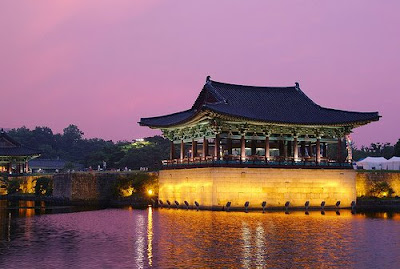
Anapchi (Pond of Ducks and Geese) is a complex where royalty would hold banquets. (e.g. get drunk) There were a total of 26 buildings but only 3 remain. They are in talks about rebuilding more but we'll see if they actually do it. Still a pretty neat and relaxing place to spend an afternoon at.


This is one of the pagodas they will be reconstructing soon. This belongs to Hwangryongsa (Temple of the Imperial Dragon) which was razed back in the 1200's by the Mongols. This was the biggest pagoda in East Asia at the time. It will definitely be a sight to see once it is completed in 2035. The rest of the complex will be built after the pagoda. I've heard that Buddhist monks are leaping for joy!


Woljeonggyo (Moon Bridge) This is a 216 feet long bridge that once connected Anapchi (the pond from above) to the main palace. It's twin Iljeonggyo (Sun Bridge) will be built right after this one is finished. I saw a scaled down version of this at the pond and I was quite impressed.

6.12.2008

danwon

Kim Hongdo (1705-1806), or better known as Danwon. My favorite korean painter. He is considered one of the three most famous and valued painters in Korea. Much like the genre paintings of the Dutch, Danwon painted scenes of daily life. If one looks closely, Danwon's paintings are comical, dynamic, and in-touch with real life. The style of his work reminds me of today's comic books but obviously, they carry a lot more meaning than the former.

In this painting, a boy is dancing while the musician play traditional Korean instruments. The man at the top right puffs his cheeks with air as he plays his wooden flute.

Workers add tile to the roof of this pavilion. The workers are serious and diligent as shown by their facial expressions.


The quintessential depiction of Korean life, whether it was five hundred years ago or today. The students are studying hard and the poor little boy is crying probably because he was lazy or did not live up to the expectation of the teacher. I guess nothing's really changed here in Korea.

2.01.2008

the city of filial piety and samsung

Last weekend, my friends and I decided to take a trip to Suwon, a city an hour south of Seoul. A king back in 1796 had tried to move the capital city from Seoul to Suwon but failed miserably. The story goes that the king missed his deceased father so much that he decided to build him a great tomb. Instead, the tomb ended up becoming a fortress. The king then wanted to be closer to his father's burial place so he tried to move the capital. I think it's a neat story of honor and love. An interesting side note, Suwon happens to be where Samsung headquarters is. This is where all those designs for cellphones, flatscreen TVs, and flashdrives come from.


Prost! I think that's German for Cheers. My German friends taught it to me when we were in Suwon.