Showing posts with label los angeles. Show all posts

8.09.2011

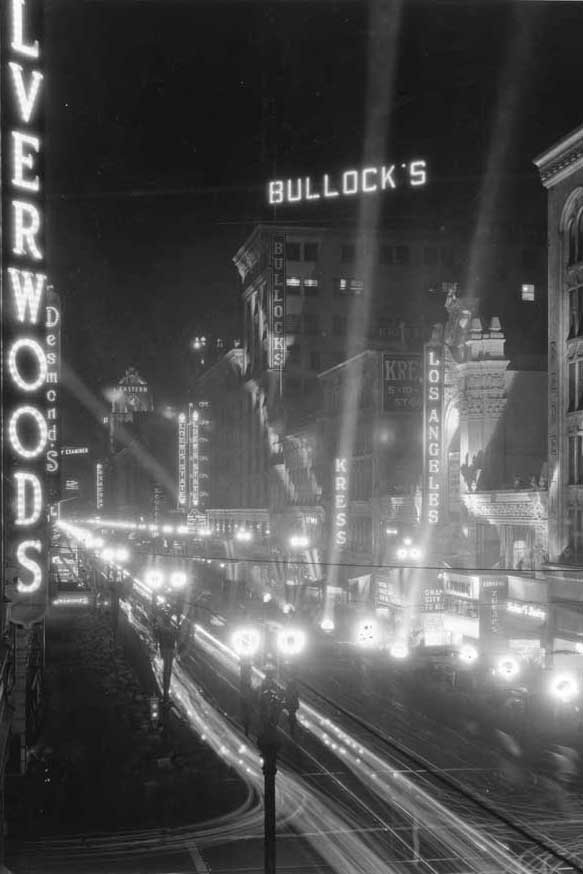
downtown's heyday

Los Angeles in 1952 before all the skyscrapers came in. One can see the Alexandria Hotel (which still exists) and the wonderful Eastern Building in the background. 

Above is the the Hall of Records which was unfortunately demolished in the 70's and below the Eastern Columbia Building. 


Above is the Richfield Building which was demolished in the 60's and below a picture of Broadway during a time when it actually flourished and was a destination for culture.


4.07.2011

the urban shift?

People supporting suburban sprawls use recent figures of the declining population of most major cities as proof that suburbanization of America continues. Unfortunately, figures do not tell the entire story. With governments turning towards austerity and refocusing on sustainable development, it is curious that one study shows, on the contrary, the downtowns of american cities actually growing. Yes, this does mean that cities are shrinking but more people are turning towards denser areas. Areas where people can walk or take public transportation to work, to the grocery store, to wherever they are headed.

This isn't anything new. The cities that we know of today all began as dense settlements and slowly became centers of commerce, education, and the arts. Cities in Western Europe or Eastern Asia have always been the heartbeat of the country. It was during the baby-boomer generation that America saw people moving away from the city and creating large suburban sprawls. (especially in places like southern California) This led to the decay of cities (New York and Los Angeles during the 70's and 80's were thought of as very dangerous places, ridden with crime and gangs) and a flourishing of small towns and a car-centered life. But before I offer my criticism of such a lifestyle, I will say that the suburban life is indeed nice and comfortable. Suburbs offer much more space and are safer and cleaner than cities. One could actually own property and a home for much less.

There will always be suburbs and even rural areas, and I do believe that there is a place for them. My only qualm is that the suburbanization of America was not a sustainable lifestyle for such a large group and now my generation will have to deal with its consequences. Because of voracious appetites for houses, developers built and people bought even if they couldn't afford it and the housing market crashed. Because the baby-boomers worked hard (which is a good thing), they thought they deserved generous retirement benefits and pensions (a bad thing and perhaps has nothing with urban or suburban life but I still want to include it), governments are bankrupt. Because of the car-centered life, we've become dependent on gas and the price continues to climb. This doesn't seem sustainable.

One allure of the suburbs was the ability to own a home and actually make money. It seems that many (here, here, here, here) (though arguable) are saying that what we saw in the last half of 20th century will never happen again. They say many in this generation will not be able to ever own a home. Some critics are optimistic that the housing market will come back up. People will always need a place to live they say. The one thing they don't take into consideration is that housing markets do go up when the job market in that particular area goes up as well. And unfortunately, that most likely will not be ameliorated anytime soon.

Many educated people of the post-baby-boomer generation are choosing to stay in cities because it offers many things that they did not experience as kids. They see the cities as an exciting place, where one can meet people, try new foods, and go to art shows and concerts. They do not need to drive as often. Thus, we are seeing a revitalization of cities. Go to New York and see how exciting of a place it is.

Washington recently opened up the Office of Urban Affairs in order to address sustainable urban living. They want to see more public transportation and better school systems in the cities. (here, here) Cities in return are investing heavily in railway. Inner city school problems are constantly being addressed. (Though we still have to wait and see whether anything happens at this time) Perhaps we will lose our individual space and landscaped yards but in the long run, I believe that our government is focusing on the right things. I do hope that people can see that we need to sacrifice our personal desires for the greater good of the society.

3.17.2011

the eastern columbia building

Considered one of Los Angeles' most beautiful buildings, the Eastern Columbia sits at the end of Broadway and served as the headquarters for the Eastern Outfitting Company and the Columbia Outfitting Company. It was designed by Claud Beelman and constructed by September of 1930 in the zig-zag Moderne Style. It later became offices and slowly fell into disuse but was fortunately saved from the wrecking ball (unlike the Richfield Building). In 2006, the building was converted into condominiums by the Kor Group and now is a highly sought after place to live.

The building is cladded in turquoise terracotta tiles and accented with gilded trimmings. Christopher Hawthorne, a Los Angeles Times architectural critic wrote that it is "one of the most beautiful pieces of architecture in the city, a building that would be world-famous if it were located in Manhattan or San Francisco. Hopefully, as Downtown L.A. gentrifies and becomes a desirable area to live in, the building will indeed become well-known.


The zig-zag lines and the heavy geometric depictions characterize the zig-zag Modern Style. One can see the sun at the center of the metalwork with the rays projecting out as stylized plants. The gilding is said to be actual gold dust. 

3.11.2011

the richfield tower

The Richfield Tower was a twelve-story art deco structure completed in 1928 and served as the headquarters of the Richfield Oil Company until 1969. In 1966, Richfield merged with Atlantic Petroleum and formed the ARCO company. The tower was then dismantled and two new skyscrapers went up for the new company. To many however, the destruction of the building was arguably one of the most regrettable decision made in Los Angeles' architectural history. 

The building was designed by Los Angeles architect Stiles O. Clements with a black and gold facade to symbolize oil as being 'black gold.' The building was crowned with a tower that was suppose to represent an oil-well gusher. The tops were also lined with sculptures of angels sculpted by Haig Patigian.


There were forty angels that were salvaged but only a handful remain. The one above is now back in downtown. Four others are in a sculpture garden at UC Santa Barbara. Below are the elevator doors that were also saved.


The ARCO towers came the replace the building. Many people today detest these modern skyscrapers but at the time it was built, I am sure that people hailed it as progress. It was modern, sleek, shiny, and very tall. Very few people in the sixties were actually concerned about preserving older buildings and therefore, I think we should be fair to the people who designed and constructed these buildings. A good historian does not think with his or her own preferences and emotions and hopefully tries his or her best to understand the people of that time. And I think we should step away from what our contemporary senses tell us and enjoy it for what it is (Although as a modern person, I would also prefer to have the old building). 

11.10.2010

westwood at a glance

Westwood was first conceived in the 1920's and all the buildings originally followed a mediterranean theme. Today, the architectural styles of Westwood is more of a hodge-podge having collected buildings erected in the subsequent decades. Many of the old mediterranean buildings and tile work remain fortunately.


If you have visited Westwood before, the first thing you will notice is the building on the left. Today it is a sushi place called Yamato but it originally began as the office of the Janss family corporation. In this picture, it is a Bank of America.


Another view coming up on Westwood Blvd. That intersection is quite busy today but back in the day, a stop sign was all that was needed to serve traffic.


The building we all know as Peet's Coffee was originally a Ralphs! And where the Standard Gas Station once stood is now the mundane brick building that foreign students come to learn English in.


How it looks today, with that ultra modern building in the background. 


Another view coming up through Broxton Avenue. The Fox Theater looks just like how it did back then. 


A picture from the seventies when they started building tall skyscrapers along Wilshire Blvd. Notice that the medical building has not yet realized the huge monetary potential of humongous advertisements that it generously slaps onto the west facade today. 


A more modern addition that developers razed last year to build something. That something never came to be and it is now there's just a big hole in the ground.


This proposed building is planned to go where the Hollywood Video was, at the corner of Glendon and Wilshire. Hopefully we will see this building go up soon because it's beautiful.

11.01.2010

will visits los angeles

William Tidwell facebooked me two weeks ago to tell me that he would come for a visit. The following week he drove ten hours from Utah and safely arrived in Los Angeles. I hadn't seen Will since May of 2007 when we had parted ways in Daejeon, Korea. His contract was up as an English teacher and he subsequently went to the University of Hawaii for his Bachelors. I still had six months or so left on mine. 

Will is pretty spontaneous and I like that about him. Willing to go anywhere and experience strange things. I think it's a trait that very few people have. He doesn't seem to worry too much and it definitely relaxes those of us who tend carry around the burdens of the world. 

I drove him around to many parts of LA and it might perhaps be true that I had more fun than he had going through our neighborhoods. I hadn't yet been to Los Feliz and so I took him there and went through all the hipster cafes, vintage shops, and a bookstore. We quickly went to the observatory, drove from Silver Lake to Beverly Hills on Sunset, and ate lots of Korean food. We spent an entire day in downtown admiring all the old and new buildings. We had novelty ice cream, rode the subway and trams, and people-watched. We also hit up a jjimjilbang, one of those Korean bathhouse, and it was remarkable indeed.

On the left, the wonderful Eastern Columbia Building. One of my favorites in the historic core. On the right, Will admiring his Walt Disney Concert Hall pictures.

10.20.2010

how it was a hundred years ago

This was Los Angeles once. A little bit of perspective can make one quite thankful. 

How it was a Hundred Years Ago by George Garrigues 

If you were living in Los Angeles a hundred years ago: 

You would take the streetcar to work. Another streetcar might kill you when you got off. You would work six days a week. If you were a bank clerk you would work Saturday nights. If you were really, really lucky you might get a week’s paid vacation. Perhaps a 10-year-old would be piloting the elevator in your building (don’t worry; the building wouldn’t be higher than five or six floors). You would shop Downtown (even, perhaps, for groceries). 

If you were black, you would live near the railroad tracks. If you were black you could be a policeman or a fireman, but not police chief or fire chief. You would have to sit in the balconies of the theaters. You could be a lawyer or a doctor or a minister or a porter. If you were white and had a fancy title or owned a business, you might live on Ninth Street or on Adams. 

If you lived in Hollywood, you might be raising flowers or fruits. If you lived in the San Fernando Valley, you definitely would be raising something or growing something or tending to some kind of animal. 

If you spoke Spanish in your home, you would be called a cholo. A cop could arrest you ‘on suspicion’ and then try to figure out what to charge you with. You could be arrested for speaking to a crowd without a permit. You might be treated with radium and milk for breast cancer. 

You could take Angels Flight to your mansion on Bunker Hill. If you were a police officer, you might have to work from 3 a.m. to 6 p.m. You wouldn’t have a union or even an officers’ association. Likewise, a streetcar conductor would work from 5 a.m. until 11 p.m. (well, on the Fourth of July at least). 

You could go to see a “coon show,” or even be in one if you had some blackface makeup (or already had a black face). You could see Lillian Russell, Sarah Bernhardt or Booker T. Washington — in person. All ladies would be women, but not all women would be ladies. You would have to buy textbooks for your schoolchild at jam-packed Downtown stores. The schools would be overcrowded. If you were a woman you could join a club and try to do good things for your community and your country. You could also work six days a week in a department store. If you were a married woman, you would always use your husband’s name, with Mrs. in front of it. 

You would take the Pacific Electric to Venice or Long Beach as often as you could, unless you already lived there. If you lived in Venice, you could get fifty dollars in gold for having a baby there. If you lived in San Pedro or Wilmington you might decide being a part of L.A. would be better than watching your trees die of thirst. You could go to an ostrich farm and see them pluck the ostriches. 

It's very unlikely you’d be one of the 20 people murdered in a year within the city limits. Ghouls might dig up your grandparents’ bones. No, strike that; your grandparents were probably neither born nor buried in Los Angeles — unless you were of Mexican (or French) descent. You would get the flu in December or January, but you would call it the grippe. 

If you were Chinese, there would be about 3,000 other people like you living in or near the Plaza, and most white folks would think you odd, dirty and smelly. You would probably be a man and, if so, you would wear your hair in a pigtail. But you’d be allowed to march in the Fiesta parade — because then you’d be considered colorful. 

Your local minor-league baseball team would be called the Looloos. You could get two years in the clink for stealing seven cents from a church poor box. You’d be shocked that the donor of Griffith Park was charged with trying to murder his wife. But you’d be happy that she survived and divorced him. 

If you were a man living in Hollywood, chances are you would vote to outlaw the sale of beer and wine except at drug stores. If you were a woman living there, you couldn't vote. If you lived in Watts, you’d be surrounded by nature. If you died, chances are your final illness would be diagnosed as tuberculosis.

12.08.2009

a surprise


It was pouring yesterday. It did feel good to be indoors but it was deathly cold in the apartment. I couldn't sit still for more than an hour. I had to study for a Chinese final but I was distracted by how cold it was! To keep moving and warm, I tried doing laundry. It turned out that laundry made me even colder and distracted. I had to walk over the next building to do it, got wet in the process, and lost ONE sock. (This wouldn't be so bad if it weren't for the fact that every time I do laundry, I lose ONE sock!) The only redeeming factor was that I got a free car wash. For that, I am truly grateful.

As I shook and shivered, and tried to get my mind off the cold, somebody began knocking at the door. Who could that be in this awfully wet and cold weather I thought and immediately sprinted to the door. It was a surprise package! I looked at the return address to see who had sent it and it was from Chie... in JAPAN! (Every time I get boxes from people from foreign countries, it really makes me happy. There's some thing more special about it than 'normal American' packages)


I open it up and it's a little package of goodies and a book. It's a book called "Kitchen" and Chie says it was her favorite book when she was thirteen years old. I hope my Japanese level is at least at a junior high level because it would be embarrassing to tell her that the book is too difficult to read.

Well, after the big surprise, the rain stopped and I saw the most ginormous rainbow I had seen in my life! My balcony is littered with really ugly contraptions but the rainbow definitely out shines the ugliness.


8.18.2009

couchsurfing

Back in Korea, while on a trip to Mount Songni with a couple of my friends, we happened upon a German who had studied abroad a year in Mexico and was slowly making his way back home. He mentioned that he was couchsurfing and immediately it sparked my interest.

Now a year later, back home in Los Angeles, I've hosted about fifteen people (mostly from Europe) and some of them have become very good friends. When I tell most people that I do this, they initially gasp for air and seem ready to brand me as being insane. Quickly, I must explain the nature of the exchange and redeem myself. I inform them that one does not need to accept everyone that they come into contact with. They are free to go through their profile and reviews. Then I tell them stories of some awesome experiences and that will usually calm them down.


Remco and Abel from the Netherlands and I. They had been traveling for six months, mostly in South East Asia. Los Angeles was their last stop before heading back home. One of my favorite guests that I have hosted.


Iwan from Switzerland and I. Probably my favorite guest. I promised to come visit him in Switzerland in the near future.