Showing posts with label japan. Show all posts
Showing posts with label japan. Show all posts
4.08.2011

3.11.2011
the first mall in seoul 19:48
The first department store in Seoul was the Gyeongseong Branch of Mitsukoshi (三越京成支店), built in 1930 and designed by Japanese architect Hayashi Kouhei. It is one of the few structures that actually survived the Korean War. In 1963, the Samsung group took over the building and began the Shinsegae Department Store (신세계 백화점) and in 2007, it was remodeled with escalators.
During the colonial era, this department store was one of two Western-style buildings that ordinary Koreans could enter (the other being Seoul Station). It is here that concepts such as 'modern boy' and 'modern girl' entered the vocabulary of young Korean people.


A view of it today at night

During Christmas

In 1914, Japan opened its first Mitsukoshi in Nihonbashi in Tokyo modeled after department stores in London (Harrod's) and Paris (Le Bon Marché). Sixteen years later, the Seoul branch would open.

Harrods in London, 1898

Le Bon Marché, 1850
10.06.2010
reconstruction of the kingdom of baekje 21:08
Baekje was one of three kingdoms that endless fought for dominance on the Korean Peninsula until its demise from a combined Silla-Tang onslaught in the year 660. Many government officials and aristocrats, instead of being captured by the incoming force, committed suicide by drowning in the Baekma River. Others fled to the court in Japan and were warmly welcomed into the royal court.
According to the Nihon Shoki and Samguk Sagi, we know that Baekje and Yamato Japan had a very close relationship. Architects, scholars, doctors, and priests from Baekje went to the Yamato court to spread Buddhism, writing, architecture, and other advanced continental ideas. Sadly however, for the past fifty years or so, this idea was a point of major friction between many Korean and Japanese people. The question of who influenced who, who created what, or what really happened in history had severe ramifications on the history of the time. Imperial Japan in the early 20th century used this relationship as one of their justification for annexing Korea for instance.

Today, save for a few artifacts and some stone pagodas, not much has survived. So when the city of Buyeo (Sabi, the old capital of Baekje) decided to bring back the main palace and a temple 1500 years later, it definitely did stir mixed emotions. The skeptics and pessimists knew that the buildings could never be reconstructed to what they actually looked like since no architecture from the kingdom has survived. Those excited did not care for the integrity of the architectural style of course since a complex like this would bring in tourist dollars as well as some pride in knowing that a great kingdom had existed there. The city went ahead and fourteen years later, the complex of Sabi Palace, Neung Temple, and a peasant's village was opened to those curious about this lost kingdom.

Without any intact architectural examples, the architects who build the complex began with a chimi that was discovered at the site of Mireuksa Temple, Baekje's most important state temple. This chimi bore close resemblance to those used on temple architecture that come from that time period in Japan. From there, they went to Japan to find inspiration for the palace and temple, knowing that Baekje architecture and Asuka Period Japanese architecture were similiar. Horyuji Temple for instance is a fine example of Asuka Buddhist architecture. Although the chimi does not adorn the roof of this particular temple, it can be seen in many other examples in Japan. The five story pagoda at Horyuji Temple was probably one of a few inspirations for the five story one in the new Neungsa Temple complex. This pagoda is Korea's first reconstructed wooden pagoda and perhaps the impetus for their revival. All pagodas were burnt down in invasions and self-inflicted temple fires. I really hope the trend will continue.

4.19.2010
innovation 15:12
Nothing is ever too objective but charts and graphs give us a good picture of what is generally going on in the world. So what can this list of the fifty most innovative companies tell us?
1) US still dominates in innovation. 22 out of 50 companies are American. If one breaks down the companies by their countries, it would go something like: Japan in second with five, China and Britain with four, Germany and Korea with three, Switzerland, Canada, Italy, Brazil, Finland and Spain with one each.
2) Innovation is increasing in Asia (13 in total). Especially as China rises, the number of innovations, patents, and companies will naturally increase as well. We see this in the number of patents Asia is producing (The top three patent holders are America, Japan, and South Korea) and even in the number of gold medal counts at the Olympics.
3) Innovation is decreasing in Europe (11 in total). Although still a very affluent part of the world, many continue to wonder when and if Europe will ever be as powerful as it once was. Or perhaps, the social Marxist bent of many European governments tends not to lend itself to innovation? I personally wouldn't care to work hard to create if the government took care of all my needs. (Although with the collapse of certain economies (i.e. Greece), the E.U., especially with Germany's lead, is slowly realizing that their socialist governments were unsustainable and unrealistic. While our country, on the contrary AND unfortunately, goes the other way.)
4) Brazil is listed as well (although the one company seems to be an oil company). Will we start to see more companies from other parts of the world?
12.08.2009
a surprise 14:03

It was pouring yesterday. It did feel good to be indoors but it was deathly cold in the apartment. I couldn't sit still for more than an hour. I had to study for a Chinese final but I was distracted by how cold it was! To keep moving and warm, I tried doing laundry. It turned out that laundry made me even colder and distracted. I had to walk over the next building to do it, got wet in the process, and lost ONE sock. (This wouldn't be so bad if it weren't for the fact that every time I do laundry, I lose ONE sock!) The only redeeming factor was that I got a free car wash. For that, I am truly grateful.
As I shook and shivered, and tried to get my mind off the cold, somebody began knocking at the door. Who could that be in this awfully wet and cold weather I thought and immediately sprinted to the door. It was a surprise package! I looked at the return address to see who had sent it and it was from Chie... in JAPAN! (Every time I get boxes from people from foreign countries, it really makes me happy. There's some thing more special about it than 'normal American' packages)

I open it up and it's a little package of goodies and a book. It's a book called "Kitchen" and Chie says it was her favorite book when she was thirteen years old. I hope my Japanese level is at least at a junior high level because it would be embarrassing to tell her that the book is too difficult to read.

Well, after the big surprise, the rain stopped and I saw the most ginormous rainbow I had seen in my life! My balcony is littered with really ugly contraptions but the rainbow definitely out shines the ugliness.

11.04.2009
east asian economic bloc 19:18
I am sure most people in America do not really know or care for that matter, but this year is the first year that the combined GDPs of China, Japan, South Korea, and the Association of South East Asia Nations (ASEAN) equaled to about 12.67 trillion dollars or 21.1 percent of the world's GDP. This is significant because by next year, East Asia's economic bloc will surpass that of the Euro bloc. By 2014, it is set to equal that of the US.
While the economies of the West continue to decline, Asia's continues to grow, mostly of course through its interaction with China. There is much talk these days about integrating their economies - much like what has happened in Europe. Even Japan, with its newly elected liberal government, is courting South Korea and China and resuming stalled talks on Free Trade Agreements and historical issues that were left more or less unresolved. They are also trying to rebuild their military so that they will not have to rely on the US. South Korea has just landed a Free Trade Agreement with the European Union, yet another possible strategy to lessen American influence. (Although the FTA with America is still pending. Where that goes, who knows...) Naturally, this makes the US uneasy as two of their allies are now trying to break away American influence and assert themselves more.
Will China be able to claim once again, their position as the biggest economy in the world? I personally hope not.
8.31.2009
towards economic integration 00:38
Busan, South Korea and Fukuoka, Japan have decided to create an economic zone that will become, hopefully, the seventh largest economic hub in Northeast Asia. For those of you that don't know how close these cities are, a speed boat will get you across the strait in less than three hours. I've done it once but I got real seasick on the way back to Busan. Going to Fukuoka was fine though...
This would be the first step towards full economic integration of Korea and Japan. (Or at least they would hope.) The democratic party of Japan winning a majority seat in parliament just recently could, however, make this a reality. The beginnings of an East Asian Union?
12.18.2008
shotoku 04:42
For the past two weeks, I've been writing my final essay for my grad class and I think I've finally got it to where its decent. I'm not all that happy with it but I want to turn it in asap because I've been at this topic for a whole 12 weeks! I'm so tired of rereading this book (I've done it five times now) and rewriting every sentence in my essay. Sadly, it makes me wonder if I can actually continue on to a phD knowing that just 12 weeks will drain all the fun out of a topic I initially enjoyed. Oh the joys of graduate school.

We were assigned a book and we had to pretty much give a class lecture on it and turn in a book review/essay (the longest book review ever I would add) at the end. I chose to read a book by Michael Como called Shotoku. It pretty much deals with the origins of the Japanese (with at least those in power), nationalism and how it pretty much destroys everything nice about history, and most importantly, a historical/mythological man by the name of Shotoku Taishi. He is pretty much like our founding fathers except he did it all by himself and most of what he did according to Como was fabricated. A book like this would never be written in Japan and if it did, it would not definitely not be a best-seller. A fun read nonetheless for those who can get beyond nationalistic tendencies.
12.15.2008
winter time 20:02
I've been back in L.A. for about 12 weeks now and I honestly forgot that I once had a blog...


A recap of my 12 weeks back in America:
1) Got a free one-week layover in Japan on my Seoul-Los Angeles flight. Got to see my friend Wataru, visited Osaka, Kyoto, and Uji on my own, and met a kind lady in Nara who gave me a full on tour for free. That weekend, I met my friends Brian, Jen, and Angela in Tokyo and went to Nikko. Wataru took us to Tsukiji Sushi house and I had the best sushi of my life there.
kinkakuji in kyoto
bustling downtown osaka at night
2) Went to Joshua tree with Kaleo the weekend I got back. It was so awesome and refreshing to be a part of the fellowship again.
3) Started grad school the week after that. My classes included Chinese 1, Japanese Linguistics, and an art history/archaeology class on early Japanese temples. The quarter is now officially over but I'm still writing a paper for the Japanese art/archaeology class. We, as a class, asked our professor about the prompt and he replied, "Do your best!"
4) For next quarter, I will be taking Chinese 2, Italian 1, Readings in Japanese, and a grad class on ancient city planning in East Asia. And yea, I know Italian seems a little out of place.
5) I'm kind of on winter break. No classes to go to but my professor for my grad class assigned us nine books and a research project to start on all before his class starts in January. I don't mind reading but when each book is over 600 pages, it is a little overwhelming. As of now, I've read 5 chapters of a book on city walls and started another on the history of China. It's gonna be a looong three weeks.
7.20.2008
the most economically powerful cities 21:52
1) London, England.
GDP: 452 billion. population: 8,567,000.
2) Hong Kong, China.
GDP: 244 billion. population: 7,206,000.
3) New York, USA.
GDP: 1.13 trillion. population: 19,040,000.
4) Tokyo, Japan.
GDP: 1.19 trillion. population: 35,676,000.
5) Chicago, USA.
GDP: 460 billion. population: 8,990,000.
6) Seoul, Korea.
GDP: 218 billion. population: 9,796,000.
7) Paris, France.
GDP: 460 billion. population: 9,904,000.
8) Los Angeles, USA.
GDP: 639 billion. population: 12,500,000.
9) Shanghai, China.
GDP: 139 million. population: 14,987,000.
10) Toronto, Canada.
GDP: 209 billion. population: 5,213,000.
From Forbes.com
6.09.2008
the ainu people 07:08
Japan has finally agreed to officially recognize the Ainu people of Hokkaido as an indigenous people "with a unique language and culture." For centuries, they have been repressed and neglected and many had to hide their identities so they would not face discrimination. Originally they inhabited the Sakhalin Peninsula and Kurile Islands (currently part of Russia), Hokkaido, and the northern part of the main island of Honshu. Today, they only occupy the southern part of Hokkaido.
Genetically, the Ainus are very different from the Japanese. They have fairer skin and to put it bluntly, are hairier. They almost look native American. Some scholars have even speculated that they are the descendants of the Jomon People.

I was first introduced to their culture back in 2002 when I took a trip to Sapporo, Japan in Hokkaido. I went to a store that sold goods made by Ainu people and was startled by the similarities between them and the native Americans. I even found out that the city of Sapporo is the Ainu word for village of much dryness. (It's been modified of course to fit the Japanese tongue, but in the original Ainu language Sapporo was pronounced Satporo kotan with the word kotan eventually being dropped.) So the next time you drink a bottle of Sapporo Beer, remember the Ainus and their contribution to the world.
5.25.2008
rocket ship 19:19
 I saw this building back in Tokyo near Shinjuku in February and I thought it was a pretty neat building. Looks like a rocket ship in the middle of all the other buildings.
5.21.2008
blue roses 23:00
A lot of "specialists" in Asia continue to regard Asia as a mere copier of Western ideas and that they lack creativity. I tend to think that Asians (and when I say Asians I mean the Japanese, Koreans, and to a certain extent, Chinese) are just playing catch up. The reason I bring this up is because I think that these Asians ARE very creative. I'm always quite amazed by products they come up with. I think it's a shame that in the West, we never get to hear about these things.

So a while ago, a Japanese company genetically altered roses and came up with blue roses. It was suppose to be an impossible feat, a horticulturist's dream. Now it's available for people to purchase, though I've heard that it costs over a hundred bucks just for one rose.
hello kitty 02:12
Hello Kitty was just named the official Japanese tourist ambassador. The government is hoping to bring in ten million visitors a year with their new mascot. Apparently, there is a "Hello Kitty Wave" happening in China and the government hopes to bank on this.

I don't think I'll ever understand the Asian obsession with cuteness.
5.09.2008
will's last weekend 10:11
This passed weekend, Will, Rachel (Will's friend), and I went to Busan to hangout for the last time before he left for America. A couple of weeks prior to this weekend we had thrown around the idea of going to Hong Kong, Taiwan, Tsushima, or Tokyo but it just didn't seem to work out. So we ended up in Busan... again. While in Busan, we decided to go check out if there were any tickets to Fukuoka, Japan on the ferry. I honestly didn't think there would be any left because this was a prime weekend for Koreans to travel. Miraculously, there were tickets left, and that morning we left for Japan for two hundred bucks! 

 One of Fukuoka's many canals.

Will and I in Busan posing in front of an image used by the kings of Korea for their throne room.
A park in Fukuoka
When we arrived, I got hassled by the customs guy saying that I needed a specific address on my customs form. I told him that we were just going to find a hotel but he kept insisting that EVERY hotel in Fukuoka was going to be booked. Luckily, I spoke enough Japanese to whisk my way out of there. Right when we entered the city, I was determined to prove him wrong. How could EVERY hotel/motel/inn be booked?! And it turned out he was wrong. We easily found housing and spent the rest of the time enjoying Fukuoka.
Fukuoka is known for its canal and ramen. Canals are nice and ramen is very good. They have "yatai" (street vendors) that serve delicious ramen and yakisoba. Would go back just for the food.
One of Fukuoka's many canals.Ubiquitous ramen shops of Fukuoka
An older lady started talking to Rachel about something in Japanese but she had no idea. Around that same time, Will got in trouble for shooting a video of a Buddha statue and touching all the merchandise. Right then, she took us into the back and started talking to me. She was very warm-hearted and personable. We chatted for a while. We told her that we were tourists from Korea and she told me that she would be delighted to take us around for a bit. She bought us subway tickets, we talked some more, and she guided us to some ancient castle ruins and a beautiful park. And she told me that I spoke very good keigo (Japanese honorifics). It made my day.
2.12.2008
happy lunar new years 05:49
I left for Jeju Island early Wednesday morning to catch a flight to Tokyo in the evening. My friend Tim and I decided to meet down there because we would be able to avoid the madness of people traveling in and out of Seoul. Lunar New Years is one of the two biggest holidays here in Korea.

Tim took me to a bar/restaurant called Bagdad in Jeju City that served Indian food. It's a bit random that it would be called Bagdad but a lot of things here in Korea seem random. I never really liked Indian food but the food here was amazing. Definitely would love to go back there again. We then went to the airport and enjoyed what has become one of my all-time favorite fruit - Hallabongs. I believe that they are a cross breed of some Japanese Satsuma Orange and Jeju Island Mandarins. We hung out in the airport for about 3 hours or so. By 11:30 we were in Tokyo.

Tim and I stayed with my friend Takuya who I met in Tokyo back in the summer of 2006. I got to meet his family and they were especially kind and welcoming. We had dinner with Takuya's family every night so it really saved us money. The whole time however, Takuya tried convincing me into moving to Tokyo with him. He even tried looking at jobs for me. I guess it's still an option for the future... I actually would love to live there.
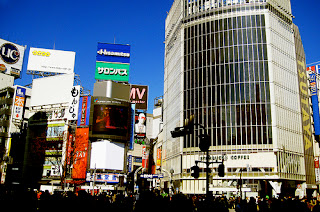 Rather than being tourists, Tim and I just hung out with people. We met our American teacher friends, Emily, Meredith, and Kirsten, who were also in Tokyo, their military friends Davia and Derek, hung out with my Japanese friends Tetsuya and Wataru, and met two British girls who were also vacationing in Tokyo.

Things I realized in Tokyo:
1) My Japanese is very rusty. Takuya even said that he noticed that I forgot a lot. Kinda disappointing. 2) Only if you want to throw away money, try avoiding Roppongi Hills. It'll drain your wallet fast. 3) I really really like Mister Donuts. 4) The taxis remind me of Transformers.