Showing posts with label korea. Show all posts

8.15.2011

architecture in gunsan

During the Japanese Occupation Period, Gunsan was a port city from which rice was exploited and sent to Japan. Many Japanese merchants settled here and grew rich. Today, many of the colonial buildings still remain along the harbor and in the old parts of Gunsan. Unfortunately for me, many of the buildings were being renovated so I couldn't get very many pictures. Although much of it tells sad stories of plunder and greed, the buildings themselves are quite beautiful and the government has done a great deed in protecting them.

Dongguksa (東国寺) is the only temple left in Korea from the colonial era. At the peak of the colonial period, there were more than five hundred Japanese style temples. This temple was originally founded by a monk by the name of Uchida in 1909 and the building itself was built in 1912. The main hall is constructed in a style that was quite popular during the Edo Period in Japan.


The Hirotsu House below was the residence of a wealthy Japanese merchant. It is an Edo-style Mansion (Yashiki) with a few modifications. Several rooms on the bottom floor employ the Korean ondol floor heating system while the rooms above use traditional Japanese tatami mats. 


Below is the Old Gunsan Customs House. It was designed by either a French or German architect in an eclectic mix of European styles in 1908. The red bricks were imported from Belgium. This was where much of the rice that was grown was shipped out from. 


8.11.2011

the myeongdong intersection

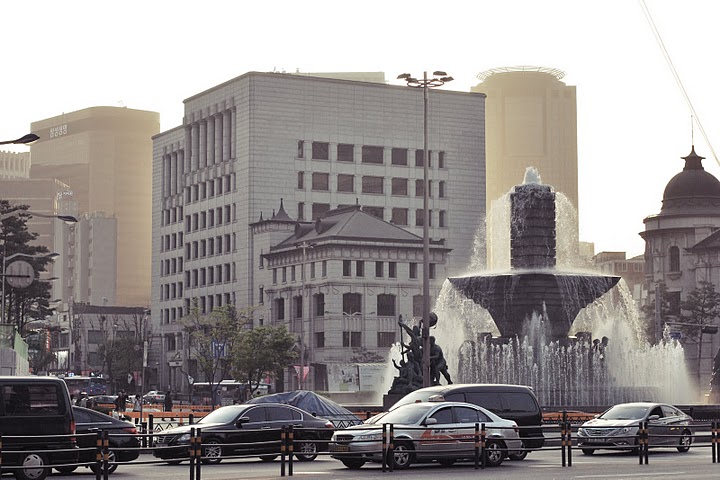
Above is a bird's eye view of what is now mostly Myeongdong. You can see the former Bank of Chosen and the Old Seoul Post office in the foreground. The Mitsukoshi Department Store has yet to built in this picture. As one follow the street just right of the bank, the street opens up to the City Hall and a large, open plaza. On the left is a close up of the intersection, with the Bank of Chosen on the left. Today, most of the other buildings have all been demolished unfortunately.
Above is the former Mitsukoshi Department Store now Shinsegae Headquarters and below the Former Bank of Chosen Bank now museum.

The former Korea First Bank.


The recently built Korea Post Office.

7.18.2011

sabi palace

I finally got to visit Sabi Palace that was recently constructed. It was indeed an impressive site. Nevertheless, being the critic I am, two things bothered me. First, the palace was not built on the original site and secondly, it felt more like visiting an amusement park rather than a site from the past. The first problem I can overlook because it really doesn't matter, except to the few zealous historians and archaeologists. I did have issues with the second. Once inside, there are speakers blasting 'traditional Korean music' and large plasma televisions inside the buildings playing history lessons. Of course those who build these things have to consider the monetary returns or else they would go bankrupt. I can understand that. But I think they were only thinking of the returns. I personally don't think they should have built the palace. Instead, they should have rebuilt the long-gone Buddhist structures that we know existed during the Baekje Kingdom (e.g. Mireuksa) and actually have them function as places of worship. Like other temples in Korea, these sites could reach a point where they would be self-sustaining.

Still, it is better than having nothing at all and I would recommend this place to anyone interested in early Korean history. There is a museum next door where you can learn a bit about the early connection between the Baekje Kingdom and early Asuka Japan.


In the background, one can see Neung Temple and its pagoda. Unfortunately, it is not used as a place of worship but is just a small part of the entire complex.


This is suppose to be a replica of Wirye Fortress, the very first fortress that was located in Seoul. It is interesting to see that the tiled and gabled roofs have not yet become a part of Baekje architecture.

6.27.2011

mireuksa

Mireuk Temple was established in 602 by King Mu of the Kingdom of Baekje. Legend says that King Mu and his queen saw a vision of the Maitreya Buddha at a pond and subsequently had the pond drained for the construction of this temple. It was then dedicated and named after the Maitreya Buddha.


The reconstructed plan of the temple is rather unique; it does not exist in China, Japan, or in other parts of the Korean Peninsula. The two stone pagodas flank the larger wooden one in the center and corridors separate it from the rest of the complex. One of the arguments for such tall pagoda structures in early East Asian History is that it was to legitimize the power of the ruling class. This can be seen in major pagoda construction during the Tang Dynasty, Silla Kingdom, and early Yamato Kingdom of Japan. The wooden pagoda is said to have been built by a craftsmen named Abiji. 


The Western Pagoda survived into modern times and is the oldest and largest stone pagoda to survive from the Baekje Kingdom. The Eastern Pagoda was recently reconstructed after extensive studies of the Western Pagoda. The Western one is now undergoing thorough excavations and will be reassembled sometime in the future. The stone pagoda showed how Baekje craftsmen adapted their knowledge of woodworking to stone. Except for the simplification of the bracketing system, most of the construction techniques mimic wooden ones.

5.19.2011

suwon

My second visit to Suwon. Many of the walls have been reconstructed and they've created a lot of green space in and around the fortress. It certainly is a pleasant sight.


Hwahong Gate allows the Suwon River to flow into the walled city.


Changan Gate is the biggest gate in all of Korea.


You cannot help but take notice of this gigantic church as it looms over the city like the Death Star. I am not sure by whom and when it was built, but its eclectic Gothic-esque architectural style and austere Protestant aesthetics suggest a recent construction and perhaps a koreanization of cathedral architecture.

3.11.2011

bank of korea

The Bank of Korea was designed by Tatsuno Kingo, the same architect behind Tokyo Station and the Bank of Japan. It was completed in 1912 and served as the Bank of Chosen (朝鮮銀行) until 1945. In 1950, the Bank of Korea was established and was headquartered here until a new skyscraper was built just behind the building. It is now the Bank of Korea Museum. It is built in an eclectic mixture of French Chateau and French Renaissance styles. 


the first mall in seoul

The first department store in Seoul was the Gyeongseong Branch of Mitsukoshi (三越京成支店), built in 1930 and designed by Japanese architect Hayashi Kouhei. It is one of the few structures that actually survived the Korean War. In 1963, the Samsung group took over the building and began the Shinsegae Department Store (신세계 백화점) and in 2007, it was remodeled with escalators.

During the colonial era, this department store was one of two Western-style buildings that ordinary Koreans could enter (the other being Seoul Station). It is here that concepts such as 'modern boy' and 'modern girl' entered the vocabulary of young Korean people.


A view of it today at night


During Christmas


 In 1914, Japan opened its first Mitsukoshi in Nihonbashi in Tokyo modeled after department stores in London (Harrod's) and Paris (Le Bon Marché). Sixteen years later, the Seoul branch would open.


Harrods in London, 1898


Le Bon Marché, 1850

3.09.2011

the old seoul post office

Certain buildings, I wish were still extant. The old Seoul Post Office being one of them. It was originally called the Gyeongseong Government Post Office (경성 우편국 청사)  and served its purpose from 1905 to the 1950's when the Korean War erupted. And it was during the war that much of it was sadly destroyed. In 1957 a three-story building was constructed until it was expanded in 1968 to serve the growing metropolis. 

The first building was constructed in the Japanese 'Imperial' Style, which was a style loosely based on late German Baroque. The red brick and whitish granite are typical of architecture in colonial Korea during the early 1900's. A central dome topped the building in typical Baroque fashion. 


By the early 1950's the building had already lost its dome and parts of its roof.


After the demolition of the original and the two subsequent (and mediocre) buildings, this is the Seoul Central Post Office today. It was designed and built by the architecture firm Space Group headed by Lee Sang-leem in 2008. 

10.06.2010

reconstruction of the kingdom of baekje

Baekje was one of three kingdoms that endless fought for dominance on the Korean Peninsula until its demise from a combined Silla-Tang onslaught in the year 660. Many government officials and aristocrats, instead of being captured by the incoming force, committed suicide by drowning in the Baekma River. Others fled to the court in Japan and were warmly welcomed into the royal court.

According to the Nihon Shoki and Samguk Sagi, we know that Baekje and Yamato Japan had a very close relationship. Architects, scholars, doctors, and priests from Baekje went to the Yamato court to spread Buddhism, writing, architecture, and other advanced continental ideas. Sadly however, for the past fifty years or so, this idea was a point of major friction between many Korean and Japanese people. The question of who influenced who, who created what, or what really happened in history had severe ramifications on the history of the time. Imperial Japan in the early 20th century used this relationship as one of their justification for annexing Korea for instance.


Today, save for a few artifacts and some stone pagodas, not much has survived. So when the city of Buyeo (Sabi, the old capital of Baekje) decided to bring back the main palace and a temple 1500 years later, it definitely did stir mixed emotions. The skeptics and pessimists knew that the buildings could never be reconstructed to what they actually looked like since no architecture from the kingdom has survived. Those excited did not care for the integrity of the architectural style of course since a complex like this would bring in tourist dollars as well as some pride in knowing that a great kingdom had existed there. The city went ahead and fourteen years later, the complex of Sabi Palace, Neung Temple, and a peasant's village was opened to those curious about this lost kingdom.


Without any intact architectural examples, the architects who build the complex began with a chimi that was discovered at the site of Mireuksa Temple, Baekje's most important state temple. This chimi bore close resemblance to those used on temple architecture that come from that time period in Japan. From there, they went to Japan to find inspiration for the palace and temple, knowing that Baekje architecture and Asuka Period Japanese architecture were similiar. Horyuji Temple for instance is a fine example of Asuka Buddhist architecture. Although the chimi does not adorn the roof of this particular temple, it can be seen in many other examples in Japan. The five story pagoda at Horyuji Temple was probably one of a few inspirations for the five story one in the new Neungsa Temple complex. This pagoda is Korea's first reconstructed wooden pagoda and perhaps the impetus for their revival. All pagodas were burnt down in invasions and self-inflicted temple fires. I really hope the trend will continue.